
Receipts attached 1 source
Sources
-
Other source
Official service information
Limits
Single operator source. Service conditions can change; consult the linked official page before travel or applying.
Corrections
No correction notes have been added for this article.
National Gallery visits: The National Gallery is free to visit, but a free ticket is not a guarantee that the painting you want will be in its usual room. The Gallery’s visitor page says building work is affecting some rooms and that paintings may be moved. For a visit built around one artist, the online location check is the most useful first step.
General admission is free, while some exhibitions carry a charge. The Gallery says visitors can book a free general-admission ticket for fast-track entry and advance information; walk-up entry is also available. Keep those arrangements separate from paid exhibition tickets, and use the ticket page for the event you actually intend to attend.
Use the Sainsbury Wing entrance
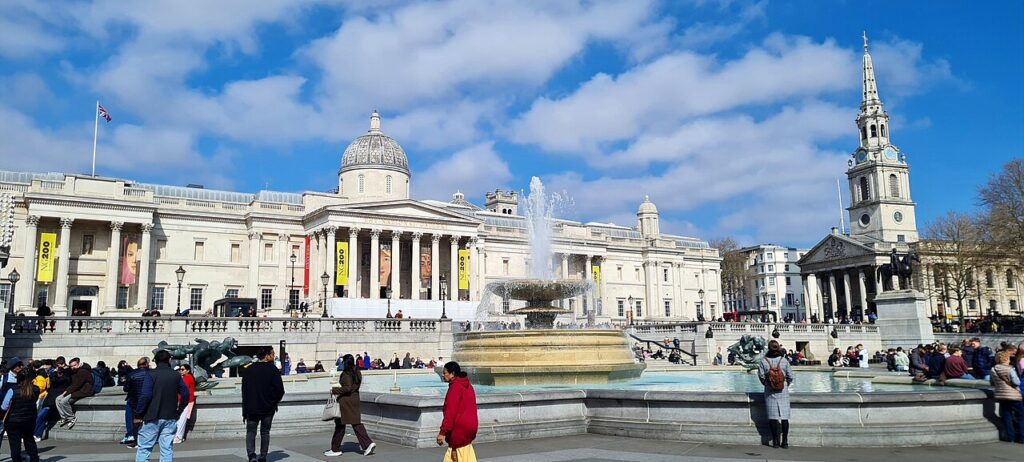
The main public entrance is the Sainsbury Wing, facing Trafalgar Square. The visitor guidance separately identifies the Roden Centre for Creative Learning on Orange Street for school groups and people attending activities there. Check the destination on your booking rather than assuming every event uses the main entrance.
The Gallery recommends consulting the floorplan for current room closures and checking the website for the location of a particular work. That advice matters even for a familiar collection. A room number copied from an old guide can be accurate historically and unhelpful on the day.
Pack for an art visit, not a travel stop
The Gallery asks visitors to bring minimal belongings and says its doors have walk-through metal detectors, with bags inspected. Wheeled luggage and suitcases are not allowed. Read the current baggage policy before combining the visit with an airport or railway journey.
Accessibility information includes accessible toilets and Changing Places facilities. Readers who need a particular entrance, facility or arrangement should follow the linked access information rather than infer suitability from the general opening page.
The collection can also be explored online, and the visitor page points to audio guides and the Smartify app. Those are useful preparation options, not requirements for enjoying the paintings. Choose a small number of works, locate them, and leave room in the plan for closures or a change of route. This is a practical guide based on the Gallery’s published arrangements, not an in-person review or a claim that every listed work was on display today.
Official visitor and service information
National Gallery visits: entry and luggage are separate questions
The current visitor page identifies the Sainsbury Wing as the main entrance, facing Trafalgar Square at the corner of Pall Mall and Whitcomb Street. It lists general opening hours of 10 a.m. to 6 p.m., extending to 9 p.m. on Friday, with closure on December 24 through 26 and January 1. Those arrangements were checked October 10, 2026. A later visit should begin with the live page, particularly around a holiday.
A free general-admission ticket is offered for fast-track entry and updates, while walk-up entry is also available. That gives a visitor two routes, not a guarantee of instant entry under either one. The Gallery says doors have walk-through metal detectors and bags are inspected. Bringing fewer belongings is its advice as well as a practical way to simplify arrival.
For visitors fitting art around a train journey, luggage deserves particular attention. The cloakroom costs £3 per item, or is free for members, and accepts bags up to 56 by 25 by 45 centimeters. Wheeled luggage, including cabin bags and suitcases, is not permitted. A paid cloakroom therefore does not solve every travel-storage problem. Arrange somewhere appropriate for luggage before planning the Gallery as a stop between trains.
The Gallery permits personal, noncommercial photography unless a sign says otherwise. It also welcomes sketching within its published materials rules, but says visitors may be asked to move to another painting or room when it is busy. Treat both as conditional permissions. The most useful visit is one organized around the works currently available and the space shared with other people, not an assumption that admission makes every activity unrestricted.