Receipts attached 1 source
Sources
-
Other source
Official service information
Limits
Single operator source. Service conditions can change; consult the linked official page before travel or applying.
Corrections
No correction notes have been added for this article.
UK Supreme Court visit: The UK Supreme Court’s Parliament Square building is open to the public, and visitors can generally sit in on a hearing when one is taking place. The court’s visitor guidance makes an important qualification: there can be specific reasons why visitors may not attend. A planned visit is therefore not a promise of access to a particular case.
The building normally opens on weekdays and closes at weekends and bank holidays. Check both the visitor page and the relevant case listing before traveling. An open building and a sitting courtroom are different things. If your purpose is to follow an argument, the hearing schedule matters more than the general opening hours.
Allow time for security
Every entry requires a security check. The court advises allowing extra time, particularly around the start of morning and afternoon business. Pack with that process in mind and consult the prohibited-items guidance before leaving home, rather than assuming the rules match those of a museum or office.
The court distinguishes public-area photography from recording proceedings. Its guidance permits photographs in public and exhibition areas but prohibits photographs or recordings inside a courtroom while a hearing is taking place. A phone that is acceptable in the building is not permission to record a case.
Text-based communication is allowed during a hearing if the device is silent and its use does not disrupt proceedings. The visitor guidance says laptops are not permitted. Anyone planning to take extensive notes should read the current instructions and choose equipment accordingly.
The alternative is to watch remotely
The court says hearings are available live and on demand through its websites. That can be the more practical route if travel, accessibility requirements or the day’s timetable make a physical visit difficult. Find the correct case page rather than assuming a clip shared elsewhere contains the complete exchange.
This is a guide to observing the institution, not advice about filing a case. Visitor access does not establish a right to speak, present documents or obtain legal advice. Parties and people seeking registry assistance should use the separate court guidance for their procedural needs. For spectators, the basic sequence is simpler: find the case, check the sitting arrangements, read the security rules and keep observation separate from participation.
Official visitor and service information
UK Supreme Court visit: what the building can explain
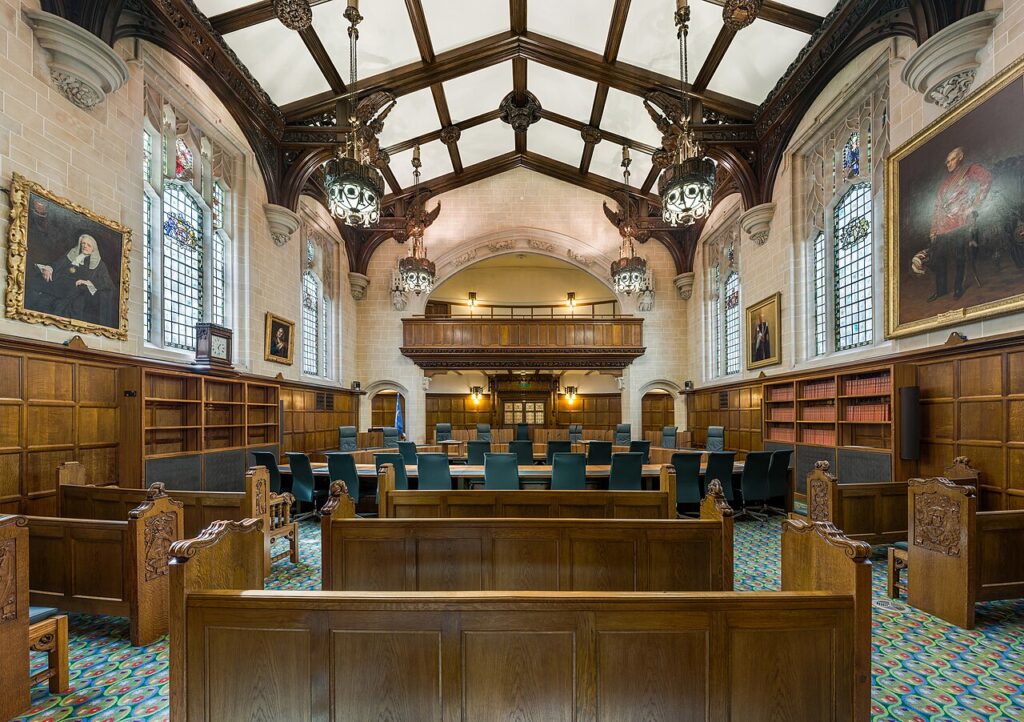
The court’s own guide describes three courtrooms over three floors, normally with two used by the Supreme Court and one by the Judicial Committee of the Privy Council. The architectural contrast is part of the visit: two rooms have traditional interiors while another has a more modern design. The Justices sit at the same level as everyone else rather than on a raised platform. These are features described by the institution, not observations from a reporter attending a hearing.
The permanent exhibition on the lower ground floor explains the court’s history and constitutional role. Its listed exhibits include ceremonial robes, judicial letters patent and an exemplification of Magna Carta in modern English. That gives a visitor an alternative focus if the hearing calendar does not match the day available. It is better to choose that itinerary consciously than arrive expecting an argument that is not scheduled.
For timing, the published building hours are Monday through Friday, 9 a.m. to 5 p.m., with last entry at 4:30 p.m. The visitor page identifies Westminster as the closest Underground station. These details were checked October 10, 2026; consult the same page for a later visit rather than treating a saved article as a live closure notice.
There is one important qualification to the normal texting rule: special restrictions can prohibit communication from a courtroom. The guide says a security officer will notify visitors before entry when such restrictions apply. Follow those instructions even if your device is silent. A public hearing is an opportunity to observe proceedings, not an exemption from the court’s directions.